

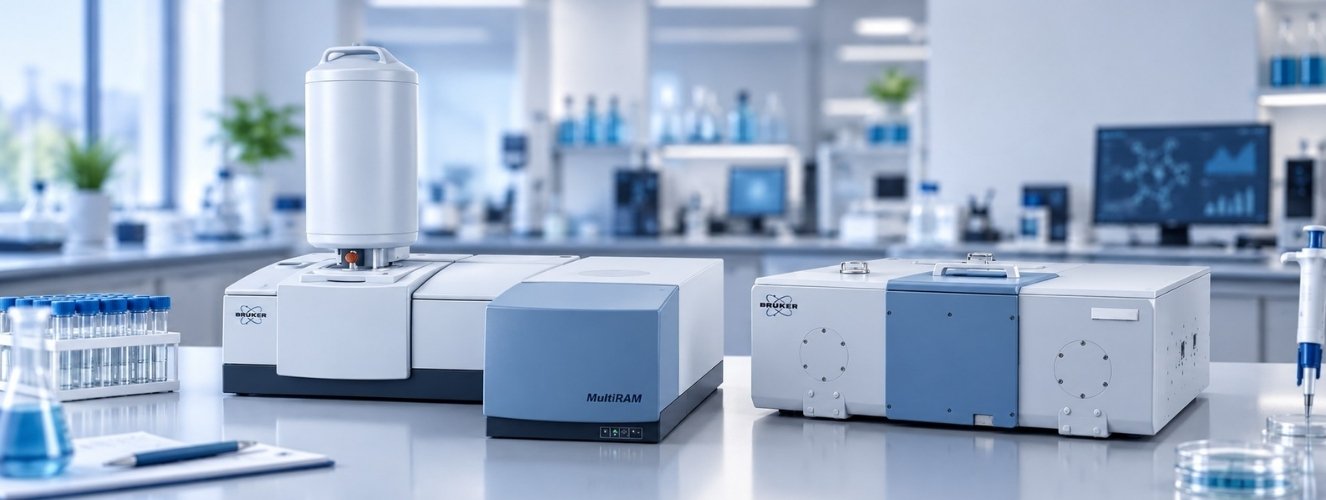
Raman spectroscopy is an analytical technique used to identify and characterise materials based on their molecular structure. It is widely used for chemical analysis, material identification, pharmaceutical testing, polymer analysis, research, and quality control.
With options ranging from benchtop systems to handheld Raman spectrometers, Raman technology can support different laboratory and field-based testing requirements. Selecting the right system depends on the sample, analytical objective, measurement environment, and required performance.
What Is Raman Spectroscopy?
Raman spectroscopy is a spectroscopic technique based on the interaction of light with molecules. When a sample is illuminated with a suitable laser, most of the scattered light has the same energy as the incident light. A small portion undergoes a change in energy due to molecular vibrations.
This change produces a Raman spectrum that can provide information about the molecular composition and structure of the sample.
Raman spectroscopy can be used for:
- Material identification
- Chemical analysis
- Molecular characterisation
- Raw material verification
- Pharmaceutical analysis
- Polymer testing
- Research and development
- Quality control
- Forensic analysis
- Identification of unknown materials
How Does Raman Spectroscopy Work?
A typical Raman spectroscopy system uses a laser to illuminate the sample.
The basic measurement process involves:
- A laser is directed at the sample.
- The sample interacts with the incident light.
- Most of the light is scattered without a change in energy.
- A small portion of scattered light undergoes an energy shift.
- The Raman system detects this shifted light.
- The resulting Raman spectrum is analysed to obtain molecular information.
The Raman spectrum acts as a molecular fingerprint that can be compared with reference information for material identification and analysis.
Why Use Raman Spectroscopy for Chemical Analysis?
Raman spectroscopy can provide valuable molecular information while requiring relatively little sample preparation for many applications.
Some key advantages include:
- Molecular fingerprinting
- Rapid material identification
- Minimal sample preparation for many samples
- Non-destructive or minimally destructive analysis in suitable applications
- Analysis of solids, liquids, and other compatible samples
- Suitable for laboratory and selected portable applications
- Ability to support chemical and material identification
The suitability of Raman analysis depends on the sample properties and analytical method.
Applications of Raman Spectroscopy in Chemical Analysis
1. Chemical Identification
Raman spectroscopy can help identify unknown or incoming materials by comparing their spectral characteristics with reference spectra.
This can be useful for raw material verification and quality control.
2. Pharmaceutical Analysis
Raman systems can support pharmaceutical applications such as:
- Raw material identification
- Material verification
- Chemical characterisation
- Quality control
- Research and development
The appropriate Raman method depends on the sample and analytical requirements.
3. Polymer Testing
Raman spectroscopy for polymer analysis can provide information about molecular structure and material characteristics.
It can complement other analytical techniques such as FTIR spectroscopy when laboratories require additional molecular information.
4. Research and Development
Research laboratories can use Raman spectroscopy to investigate materials, chemical compounds, molecular structures, and changes occurring during experiments.
5. Forensic Analysis
Raman spectroscopy can support the identification and characterisation of selected unknown materials in forensic laboratory applications.
6. Chemical Quality Control
Raman systems can be used for selected quality-control applications where rapid identification or characterisation of materials is required.
Handheld Raman Spectrometer vs Benchtop Raman Spectrometer
Raman systems are available in different configurations.
Benchtop Raman Spectrometer
A benchtop Raman spectrometer is designed for laboratory-based analysis and can provide a controlled environment for routine testing, research, and material characterisation.
It may be suitable for laboratories that require dedicated Raman analysis and more comprehensive instrument configurations.
Handheld Raman Spectrometer
A handheld Raman spectrometer provides portability for applications where measurements need to be performed outside a conventional laboratory environment.
Potential applications include:
- Raw material verification
- Field identification
- On-site chemical analysis
- Material identification
- Screening applications
The choice between handheld and benchtop Raman depends on the testing environment, sample type, required portability, and analytical objectives.
Raman Spectroscopy vs FTIR Spectroscopy
Both Raman and FTIR spectroscopy provide molecular information, but they rely on different physical interactions.
Raman spectroscopy measures Raman scattering associated with molecular vibrations, while FTIR spectroscopy measures infrared absorption.
Because their molecular selection rules differ, the two techniques can provide complementary information. In some laboratories, Raman and FTIR are therefore used together for more comprehensive material characterisation.
How to Choose a Raman Spectrometer?
Before purchasing a Raman spectrometer, laboratories should evaluate several factors.
1. Application
Determine whether the instrument will be used for chemical identification, pharmaceutical testing, polymer analysis, research, quality control, or another application.
2. Sample Type
Consider whether the samples are solids, liquids, powders, polymers, chemicals, or other materials.
3. Measurement Environment
Decide whether the system will be used primarily inside a laboratory or whether portability is important.
4. Spectral Range
Evaluate the Raman spectral range required for the materials and applications being analysed.
5. Laser Configuration
Different Raman systems may use different laser wavelengths. The appropriate configuration depends on the sample and analytical application.
6. Sensitivity and Resolution
Consider the required sensitivity and spectral resolution based on the analytical method and expected sample characteristics.
7. Software and Data Analysis
Software should support the laboratory’s workflow, including spectral acquisition, processing, library comparison, and reporting where required.
Factors That Can Affect Raman Measurements
Although Raman spectroscopy is a powerful analytical technique, measurement quality can be affected by sample and instrument conditions.
Factors may include:
- Fluorescence
- Sample composition
- Laser wavelength
- Sample surface
- Laser power
- Measurement time
- Optical configuration
- Ambient conditions
Instrument selection and measurement parameters should therefore be matched to the sample and application.
Raman Spectroscopy for Different Industries
Pharmaceutical Industry
Raman analysis can support raw material identification, quality control, research, and material characterisation.
Chemical Industry
Chemical laboratories can use Raman spectroscopy for material identification and molecular analysis of suitable samples.
Polymer Industry
Raman systems can provide molecular information for selected polymer and material testing applications.
Research Laboratories
Researchers can use Raman spectroscopy for material characterisation, molecular studies, and experimental analysis.
Testing Laboratories
Testing laboratories can use Raman systems for rapid identification and characterisation of compatible materials.
Frequently Asked Questions
What is Raman spectroscopy used for?
Raman spectroscopy is used for molecular identification and material characterisation. Applications include chemical analysis, pharmaceutical testing, polymer analysis, research, quality control, and identification of unknown materials.
What is a Raman spectrometer?
A Raman spectrometer is an analytical instrument that detects Raman-scattered light from a sample and produces a spectrum containing molecular information.
What is a handheld Raman spectrometer used for?
A handheld Raman spectrometer is used for portable material identification and analysis where measurements need to be performed outside a conventional laboratory environment.
What is a benchtop Raman spectrometer?
A benchtop Raman spectrometer is a laboratory-based Raman system designed for applications such as chemical analysis, material characterisation, research, and quality control.
Is Raman spectroscopy suitable for chemical analysis?
Yes. Raman spectroscopy is widely used for chemical and material identification because Raman spectra can provide molecular information that can be compared with reference spectra.
What is the difference between Raman and FTIR?
Raman spectroscopy measures changes in scattered light caused by molecular vibrations, while FTIR measures infrared absorption. The two techniques can provide complementary molecular information.
Conclusion
Raman spectroscopy for chemical analysis provides laboratories with a powerful method for molecular identification and material characterisation. It can be used across pharmaceutical, chemical, polymer, research, quality-control, and testing applications.
From benchtop Raman spectrometers for laboratory analysis to handheld Raman spectrometers for portable applications, the appropriate system should be selected according to the sample, analytical objective, measurement environment, and required performance.
OptiLAB Technologies provides analytical instrument solutions for laboratories and industries requiring spectroscopy and material analysis technologies. The right Raman system can be selected based on the laboratory’s specific chemical analysis and testing requirements.