

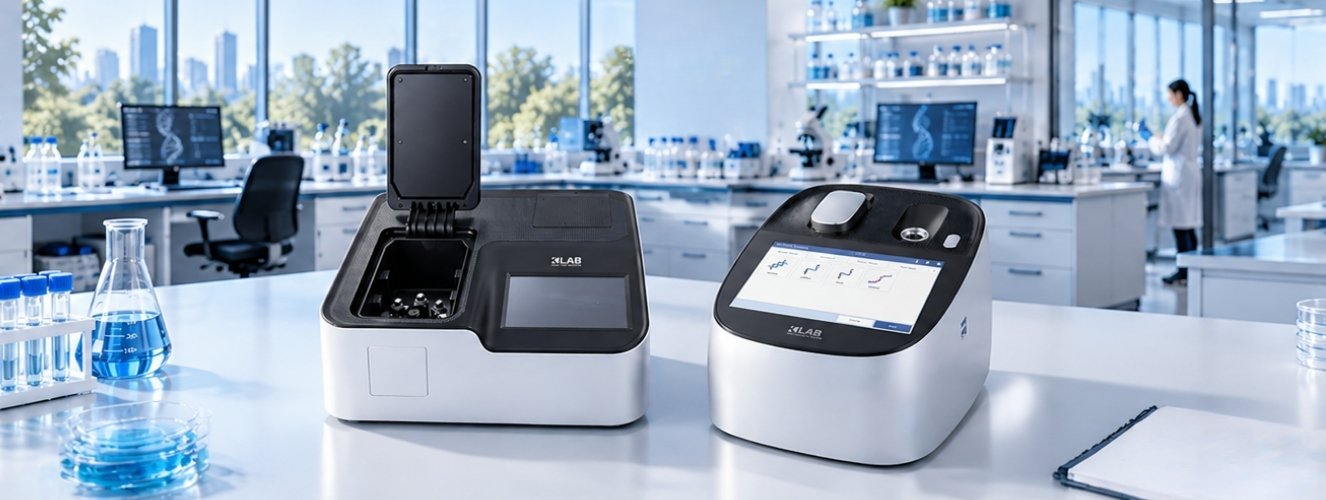
A UV-Vis spectrophotometer is a widely used analytical instrument for measuring the absorption of ultraviolet and visible light by a sample. It is commonly used in pharmaceutical, chemical, food, environmental, research, and quality-control laboratories for quantitative analysis and sample characterisation.
Because UV-Vis spectroscopy can be applied to a wide range of samples and analytical methods, choosing the right UV spectrophotometer requires an understanding of the testing application, wavelength range, sample type, measurement requirements, and laboratory workflow.
What Is a UV-Vis Spectrophotometer?
A UV-Vis spectrophotometer is an analytical laboratory instrument that measures how much ultraviolet and visible light a sample absorbs at selected wavelengths.
The instrument generally compares the intensity of light before and after it passes through a sample. The resulting absorbance or transmittance measurement can then be used for quantitative or qualitative analysis, depending on the application.
UV-Vis spectrophotometers are commonly used for:
- Concentration measurement
- Quantitative analysis
- Absorbance measurements
- Transmittance measurements
- Reaction monitoring
- Quality control
- Pharmaceutical analysis
- Chemical analysis
- Food and beverage testing
- Environmental testing
- Research and development
How Does a UV-Vis Spectrophotometer Work?
The basic principle of a UV-Vis spectrophotometer is based on the interaction between light and matter.
The instrument produces light across an appropriate ultraviolet and/or visible wavelength range. The selected light passes through the sample, and the detector measures the light that reaches it.
The difference between the incident and transmitted light is used to determine the sample’s absorbance.
The basic measurement process involves:
- A light source produces radiation.
- The instrument selects the required wavelength.
- Light passes through the sample.
- The sample absorbs a portion of the light.
- A detector measures the transmitted light.
- The instrument calculates and displays the measurement.
For many quantitative applications, absorbance is related to concentration according to the Beer-Lambert law, provided the analytical conditions are suitable.
What Is the Difference Between UV and UV-Vis Spectrophotometers?
A UV spectrophotometer is generally associated with measurements in the ultraviolet region, while a UV-Vis spectrophotometer covers both ultraviolet and visible wavelength regions.
A UV-Visible spectrophotometer can therefore provide a broader measurement range for applications involving compounds that absorb in either region.
The appropriate instrument depends on the required wavelength range and analytical method.
Applications of UV-Vis Spectrophotometers
Pharmaceutical Testing
UV-Vis spectroscopy is widely used in pharmaceutical laboratories for applications such as concentration determination, raw material analysis, quality control, and analytical method development.
The exact application depends on the compound, method, and laboratory requirements.
Chemical Analysis
Chemical laboratories use UV-Vis instruments for concentration measurements, reaction monitoring, and analysis of compounds that absorb ultraviolet or visible light.
Food and Beverage Testing
UV-Visible spectrophotometers can support various food and beverage analysis applications where measurement of light-absorbing compounds is appropriate.
Environmental Analysis
Environmental laboratories may use UV-Vis spectroscopy for selected water and environmental testing applications, including analysis of compounds that can be measured spectrophotometrically.
Research & Development
Research laboratories use UV-Vis spectrophotometers for experiments involving absorption spectra, concentration analysis, reaction studies, and material or compound characterisation.
Key Components of a UV-Vis Spectrophotometer
A typical UV-Vis spectrophotometer includes several important components.
Light Source
The light source provides the radiation required for measurement. Different sources may be used for different wavelength regions.
Wavelength Selector
A monochromator or other wavelength-selection system isolates the wavelength required for the measurement.
Sample Holder
The sample is placed in a suitable cuvette or sample holder. The material and type of cuvette should be appropriate for the wavelength and sample being measured.
Detector
The detector measures the transmitted light after it passes through the sample.
Software
Modern laboratory UV spectrophotometers commonly include software for instrument control, measurement, data processing, and result management.
How to Choose a UV-Vis Spectrophotometer?
Selecting a UV-Visible spectrophotometer should begin with the laboratory’s analytical requirements.
1. Wavelength Range
Check the required wavelength range for the applications you intend to perform. The instrument should cover the relevant UV and visible regions.
2. Spectral Resolution
Spectral resolution can be important when analysing samples with closely spaced absorption features. Select a specification appropriate for the intended analytical method.
3. Photometric Performance
Consider photometric accuracy, repeatability, and measurement range according to the requirements of your application.
4. Sample Type
Determine whether you will analyse liquids, solutions, or other compatible sample formats and select suitable sample accessories.
5. Measurement Throughput
Laboratories processing a large number of samples may benefit from features designed to simplify repeated measurements and workflows.
6. Software and Data Management
Consider software functionality, data processing, reporting, method storage, and compatibility with the laboratory’s workflow.
7. Application Requirements
The instrument should be selected according to the analytical methods and applications the laboratory performs rather than based only on individual specifications.
UV-Vis Spectrophotometer vs Other Spectroscopic Instruments
Different spectroscopy technologies are designed for different analytical purposes.
A UV-Vis spectrophotometer is commonly used for absorption-based measurements in the ultraviolet and visible regions. FTIR instruments are generally used for infrared-based molecular analysis, while Raman instruments provide molecular information based on Raman scattering.
Therefore, the appropriate instrument depends on the type of information required from the sample.
Benefits of UV-Vis Spectrophotometry
Depending on the application and instrument configuration, UV-Vis spectroscopy can offer:
- Rapid measurements
- Quantitative analysis
- Broad laboratory applications
- Straightforward sample measurement
- Support for routine quality control
- Suitable options for research and analytical laboratories
- Software-assisted data analysis
Maintenance and Good Measurement Practices
Proper instrument operation and maintenance can help laboratories maintain consistent measurements.
Important practices include:
- Follow the manufacturer’s operating instructions.
- Use appropriate cuvettes and sample holders.
- Keep optical components and sample compartments clean.
- Use suitable blanks and reference measurements.
- Follow the recommended calibration and verification procedures.
- Maintain consistent sample preparation.
- Store and manage analytical data appropriately.
Laboratories should follow the instrument manufacturer’s recommendations for maintenance and performance verification.
Frequently Asked Questions
What is a UV-Vis spectrophotometer used for?
A UV-Vis spectrophotometer is used to measure the absorption or transmission of ultraviolet and visible light by a sample. It is used for applications such as concentration measurement, pharmaceutical testing, chemical analysis, food testing, environmental analysis, and research.
What is the difference between UV and UV-Vis spectrophotometers?
A UV spectrophotometer generally focuses on the ultraviolet region, while a UV-Vis spectrophotometer covers both ultraviolet and visible wavelength ranges.
What factors should I consider when buying a UV-Vis spectrophotometer?
Consider wavelength range, spectral resolution, photometric performance, sample type, measurement throughput, software capabilities, accessories, and the analytical methods required by your laboratory.
Which laboratories use UV-Vis spectrophotometers?
UV-Vis instruments are commonly used in pharmaceutical, chemical, food, environmental, research, educational, and quality-control laboratories.
Is a UV-Vis spectrophotometer suitable for quantitative analysis?
Yes. UV-Vis spectroscopy is widely used for quantitative analysis where the sample and analytical method are suitable for spectrophotometric measurement.
Conclusion
A UV-Vis spectrophotometer is a versatile analytical instrument used across pharmaceutical, chemical, food, environmental, research, and testing laboratories. Its ability to measure ultraviolet and visible light absorption makes it useful for concentration determination, quality control, research, and a range of analytical applications.
When selecting a UV-Visible spectrophotometer, laboratories should evaluate wavelength range, photometric performance, sample requirements, software, throughput, and application needs.
Choosing an instrument based on the laboratory’s actual analytical requirements can help create an efficient and reliable spectroscopy workflow.